
Purpose
The purpose of this program is to help landowners implement suppression and thinning practices in pine stands vulnerable to devastating Southern Pine Beetle infestations. These practices aim to either suppress an active SPB infestation or mitigate the risk of future SPB infestations in vulnerable stands.
Application Process
The cost share program for the Southern Pine Beetle suppression and prevention program is now accepting applications. The sign-up period will be open from September 18, 2026 to October 9, 2026.
Click here to view the SPB application and apply. Please visit our SPB Information Page to find out more about SPB infestations and the impacts SPB have on our pine forests. The highlights of the program are listed below.
Eligibility
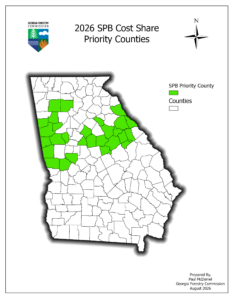
Non-industrial landowners, which means any private individual, group, association, corporation, Indian tribe or other native group, other private legal entity, excluding corporations whose stocks are publicly traded or legal entities principally engaged in the processing or manufacturing of wood products. All of Georgia is eligible to apply, but priority will be given to properties located in priority counties (see priority county map) or experiencing an active Southern Pine Beetle infestation. Minimum practice size is 10 acres to a maximum of 50 acres. If commercial thinning is the only requested practice, 20 acres is the minimum practice size. Susceptible southern yellow pine species stands are eligible.
Forestry Practices Covered
Includes commercial thinning of merchantable size trees, suppression (for active spots only), or non-commercial thinning for pre-merchantable stands.
Pay Rate
The per acre pay rate for each practice is based on 50% of the average cost of the practice in Georgia. If approved, landowners will receive approved funding amount based on the listed per acre pay rate or 75% of recorded costs, whichever is less. Maximum funding amount will be $10,000. For Commercial Thinning & Suppression practices, logger cut & haul rates will be reported to show costs. The “cost-share” in this context is intended to reduce stocking in overstocked, stressed stands and suppress active southern pine beetle spots to promote healthy forests and reduce SPB risks in the future. For suppression practices or non-commercial thinning practices that have direct costs to landowners, those invoices will be submitted for cost-share purposes. More details regarding documentation needed for the program will be shared to landowners once approvals have been made.
Management practices offered:
- Non-commercial thinning of either natural or planted pine stands ($130/acre)
- Commercial Thinning ($200/acre)
- Suppression ($200/acre)
Forestry Practices Explained:
- Non-Commercial Thinning – Stands eligible for non-commercial thinning are pre-merchantable pine stands that are excessively overstocked (>700 Trees per acre). Non-commercial thinning can be completed using hand crews and mechanical methods to reduce stocking to a healthy level. Remaining trees should be evenly spaced and desirable specimens. Overstocked stands are at much higher risk for Southern Pine Beetle infestation, so this practice aims to reduce the threat of SPB before an infestation occurs and promote healthy forests.
- Commercial Thinning – Stands eligible for commercial thinning are merchantable pine stands that exceed a basal area of 140 ft2/acre necessitating a thinning to reduce the risk of Southern Pine Beetle and promote a healthy forest. The thinning will need to reduce the basal area within the range of 60ft2/acre to 80 ft2/acre leaving desirable trees behind that will be productive and resilient to forest health issues. On commercial thinnings, a logging operation is expected to haul the harvested timber off site to a mill, and a timber contract will be needed outlining expectations and agreements during the timber operation. Please work with a licensed forestry consultant to assist with overseeing the sale and harvest of your timber. Georgia Best Management Practices will be expected to be followed during the process of any harvest operations.
- Suppression – Stands eligible for suppression are those with active Southern Pine Beetle spots that necessitate harvest of infested trees and a buffer in front of the infestation. In stands that have active beetles and have been especially devastated, suppression could extend to the totality of the stand to avoid future SPB issues. Suppression will necessitate contracting a logging crew to harvest the infested areas and any buffer areas. This practice will be used in addition to commercial thinning to potentially thin parts of the stand that are not at immediate risk of SPB infestation. GFC foresters will determine the best management technique on your stand based on the level of impact of SPB and future outlook for the stand.
If you have an active Southern Pine Beetle spot, you will need to apply for suppression practices for the entirety of that stand. That does not imply the entire stand will be clearcut; but an active SPB spot will necessitate some level of clearcutting on the stand. You do not need to apply twice for both suppression and thinning. If approved for funding, our GFC foresters will assess the area, discuss your objectives, and determine the best path forward for the stand. If the SPB impact is not yet extensive throughout the stand, commercial thinning can be conducted on the unaffected portions of the stand to maintain a healthy forest.
Example: I have a 30-acre, unthinned 16-year-old loblolly stand currently experiencing mortality due to a Southern Pine Beetle outbreak. To the best of my judgement, approximately 5 acres have been impacted so far. My objective is to maintain a forest for timber and wildlife/recreational goals. For this application, I will apply for “Suppression” on all 30 acres. If approved, a GFC forester will work with me to determine the area necessitating the suppression practices and where I could potentially thin the remainder of the stand to maintain a healthy forest to meet my objectives. However, if the GFC forester determines the SPB damage is much more extensive than I originally thought, clearcutting the entirety of the stand may be the best option. Each application will be treated on a case-by-case basis, so recommendations will be made based on the actual impact on the stand.
- No thinnings or harvests can be retroactively cost-shared. Only approved applicants that conduct operations after receiving approval will be eligible for cost-share through the Southern Pine Beetle program.
- For both Suppression and Commercial Thinning practices, a harvest contract will be required within 6 months of written approval to remain eligible in the program. If a contract cannot be acquired within 6 months, the SPB contract will need to be canceled, and funds will be reallocated elsewhere.
- Harvesting activities will need to be completed within 12 months of written approval. If the harvest operation is not complete within 12 months of written approval, the SPB contract will need to be canceled, and funds will be reallocated elsewhere.
- Non-commercial thinning will need to be completed within 12 months of written approval.
Thank you for your interest in the program. We hope this program is able to benefit landowners managing their forests to be more resilient to Southern Pine Beetle issues.
Please reach out to Matthew O’Connor with any questions regarding the application process:
Matthew O’Connor
Cost Share Coordinator
moconnor@gfc.state.ga.us
(912) 486-0760